A reuse system can operate without a financial deposit, but it places more responsibility and more risk on the operator. Without a clear reason to return reusable packaging, cups and containers are more likely to be kept, discarded or left outside the collection system. Every item that does not come back reduces the number of times it can be reused and creates additional replacement costs.
A deposit addresses the first part of this challenge: motivation. It gives users a clear and immediate reason to return the packaging. But motivation alone is not enough. If return points are difficult to find, queues are long or receiving the refund requires too many steps, some users may still decide that returning the item is not worth the effort.
Guidance published by OVAM notes that deposit-based cup systems generally achieve the highest return rates, although results still depend on clear communication, accessible return points and the audience.
A deposit creates the reason to return. A convenient refund system makes the return actually happen.
For operators, getting this balance right affects far more than the visitor experience. It influences packaging return rates, replacement costs, inventory planning and, ultimately, whether the reuse model delivers its intended economic and environmental value.
At a Glance
- A reusable package creates value only when it is returned and used again.
- A deposit gives users a clear financial reason to return packaging.
- Even small packaging losses accumulate across repeated reuse cycles.
- A deposit alone is not enough if returning the packaging is slow or inconvenient.
- Operators need both user motivation and accessible return infrastructure.
- Direct payment-card refunds can remove the need for cash, an app or account registration.

Why Return Rates Determine Whether Reuse Works
Calling a cup or container “reusable” does not automatically make the system circular. Its economic and environmental value depends on whether the packaging is returned, washed and used again enough times to replace repeated use of single-use alternatives.
This makes the return rate one of the most important performance indicators in any reuse system. A small percentage of missing packaging may appear manageable after one cycle, but the losses accumulate every time the remaining items are used again.
Consider a simplified system that starts with 10,000 reusable cups and achieves the same return rate in every cycle:
| Return rate per cycle | Cups remaining after 10 cycles | Share of original inventory |
| 90% | approximately 3,487 | 35% |
| 95% | approximately 5,987 | 60% |
| 98% | approximately 8,171 | 82% |
This is an illustrative mathematical model. It assumes that lost cups are not replaced and that the return rate remains constant. Real operations are more complex, but the comparison demonstrates an important principle: small differences in return rates create much larger differences over repeated cycles.
At a 90% return rate, an operator would retain only about one-third of the original inventory after ten cycles. At 98%, more than four-fifths would remain available. The difference affects how frequently new packaging must be purchased, how much reserve stock is needed and how reliably the system can support future events or service periods.
High return rates are therefore not simply a sustainability metric. They protect the operator’s packaging inventory and make repeated use economically viable. The more packaging that returns to the system, the more opportunities each item has to deliver value across additional use cycles.
What Happens When a Reuse System Has No Deposit?
Without a deposit, returning reusable packaging becomes a voluntary action with no immediate financial consequence. Some users will still return the item because they understand the system, support its environmental purpose or encounter a collection point at the right moment. Others may keep the packaging, leave it on a table, place it in a general waste bin or simply carry it away from the return network.
This is not necessarily a question of users behaving irresponsibly. At busy festivals, stadiums and public events, returning a cup competes with many other priorities. Visitors may be moving between stages, meeting friends, preparing to leave or trying to avoid queues. If keeping or discarding the cup is easier than returning it, good intentions may not be enough.
A financial deposit changes that decision. It assigns a visible value to the packaging and makes the return personally relevant. The user understands that the money is temporarily connected to the item and can be recovered by bringing it back.
However, this does not mean that every reuse system without an upfront deposit must fail. Some closed-loop systems use other forms of accountability, including:
- linking the packaging to a user account;
- setting a defined return period;
- charging a fee only when an item is not returned;
- limiting use to controlled environments such as offices, campuses or cafeterias;
- combining returns with loyalty rewards or other incentives.
These models still rely on a clear reason to return. They replace the traditional deposit with another mechanism that makes the user responsible for the packaging.
The greatest risk is therefore not simply the absence of an upfront payment. It is the absence of any meaningful incentive, accountability mechanism or convenient return route. When none of these elements is present, the operator carries most of the financial risk while having limited influence over whether the packaging comes back.
“A reuse system can operate without a deposit, but it cannot operate without a clear return incentive. If users have no financial, practical or social reason to bring the packaging back, the operator ultimately carries the cost of every lost item.”
Tomáš Vincze, CEO of Smart DRS
Packaging Loss Is an Operating Cost
Reusable cups and containers are not disposable supplies. They are operational assets intended to complete multiple use cycles. When packaging does not return, the operator loses not only the item itself but also all the future uses it could have delivered.
The most visible consequence is the cost of replacement:
Replacement cost = number of lost items × replacement cost per item
For example, a system that issues 50,000 reusable cups and loses 5% of them in one cycle needs to replace 2,500 cups to restore its original inventory. If a similar loss occurs repeatedly, purchasing replacement stock becomes a recurring operating expense rather than an occasional adjustment.
The financial impact is not limited to the purchase price. Packaging losses can also create:
- insufficient stock for upcoming events or service periods;
- a greater need for reserve inventory;
- additional ordering, transport and storage costs;
- uncertainty in washing and redistribution planning;
- emergency purchases with shorter lead times;
- fewer completed uses per manufactured item.
This is particularly important in high-volume environments. A shortage of reusable cups during a festival, stadium event or busy service period can affect beverage operations directly. The organiser may need to introduce additional stock at short notice, change the service process or rely on backup packaging.
Operators should therefore monitor more than the total number of items returned. Useful indicators include the number of items issued, the number returned, the loss rate per cycle, the average number of completed uses and the cost of replacing missing or damaged packaging.
A deposit helps transfer part of the responsibility for the packaging to the user. If the item is returned, the deposit is refunded. If it is kept, the unredeemed amount can help offset the operator’s loss. The primary purpose of the deposit should still be to encourage returns not to generate revenue from packaging that fails to come back.
For a reuse system to remain viable, returning the packaging must be the expected outcome. Keeping or losing it should be the exception the system is financially prepared to manage.
Deposit and No-Deposit Models: Where the Risk Sits
The difference between deposit and no-deposit reuse systems is not simply whether the user pays an additional amount. It is also about how responsibility for the packaging is distributed between the user and the operator.
| Operational factor | Deposit-based system | System without a deposit |
| Reason to return | Immediate financial incentive | Depends on goodwill, convenience or another accountability mechanism |
| Value of packaging | Clearly communicated to the user | May be less visible or understood |
| User responsibility | Clearly communicated to the user | Must be created through accounts, deadlines, fees or rewards |
| Risk of non-return | Shared between user and operator | Carried mainly by the operator unless another mechanism exists |
| Unreturned packaging | Deposit may help offset replacement costs | Replacement cost usually remains with the operator |
| User experience | Depends on how easy the refund is | May feel simpler initially, but still requires a clear return journey |
A no-deposit model may reduce friction at the point of purchase because the user does not pay an additional amount. However, that convenience can create greater uncertainty later if the system provides no equally strong reason to bring the packaging back.
A deposit-based system makes the exchange more explicit: the packaging has a value, the user temporarily holds it and the value is returned when the item comes back. This creates a simple behavioural contract that can work without requiring the operator to identify every individual user.
Neither model succeeds through payment mechanics alone. A no-deposit system needs an alternative form of accountability, while a deposit-based system needs a refund process that is easy enough to use. The right model depends on the operating environment, but the operator should always be able to answer one question clearly:
What gives the user a practical reason to return the packaging?
Why a Deposit Alone Is Not Enough
A deposit can create a strong reason to return reusable packaging, but it cannot compensate for a poorly designed return experience. If users cannot quickly understand where, when and how to return an item, even a meaningful financial incentive may lose part of its effect.
Friction can appear at several points in the return journey:
- return points are difficult to find;
- too few collection points are available;
- stations are located away from natural visitor routes;
- queues form during peak return periods;
- refunds depend on cash availability;
- users must download an app or create an account;
- return rules differ between vendors or parts of the venue;
- the system closes before visitors are ready to leave.
These barriers matter because users do not make return decisions in isolation. At a festival, they may be moving between stages or leaving with a large crowd. In a stadium, thousands of people may reach the concourses and exits at the same time. A process that appears simple during normal operation can become inconvenient when demand peaks.
Operators therefore need to design return infrastructure around real visitor behaviour. Collection points should be visible, easy to access and placed where returns naturally occur. The process should require as few steps as possible and remain consistent across the venue.
Capacity is equally important. A well-positioned return point can still become a bottleneck if it cannot handle the volume of people or the number of items returned at once. Event duration, visitor routes, expected peak times and multi-item returns should all influence the number and placement of return points.
The deposit and the return process perform different roles. The deposit answers the user’s question, “Why should I return this?” The infrastructure answers, “Can I return it easily right now?”
A successful reuse system needs a convincing answer to both.
How Card Refunds Remove Barriers to Return
A convenient refund method connects the financial motivation of a deposit with the moment when the user decides whether to return the packaging. The fewer steps required, the easier it is to turn that intention into action.
Traditional return points often depend on staff and cash handling. This can work in smaller operations, but at festivals, stadiums and other high-traffic venues it may create queues, increase staffing requirements and place additional pressure on beverage service areas.
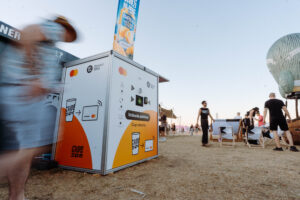
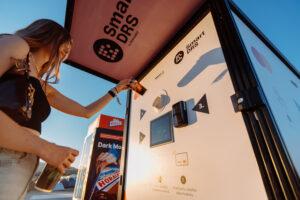
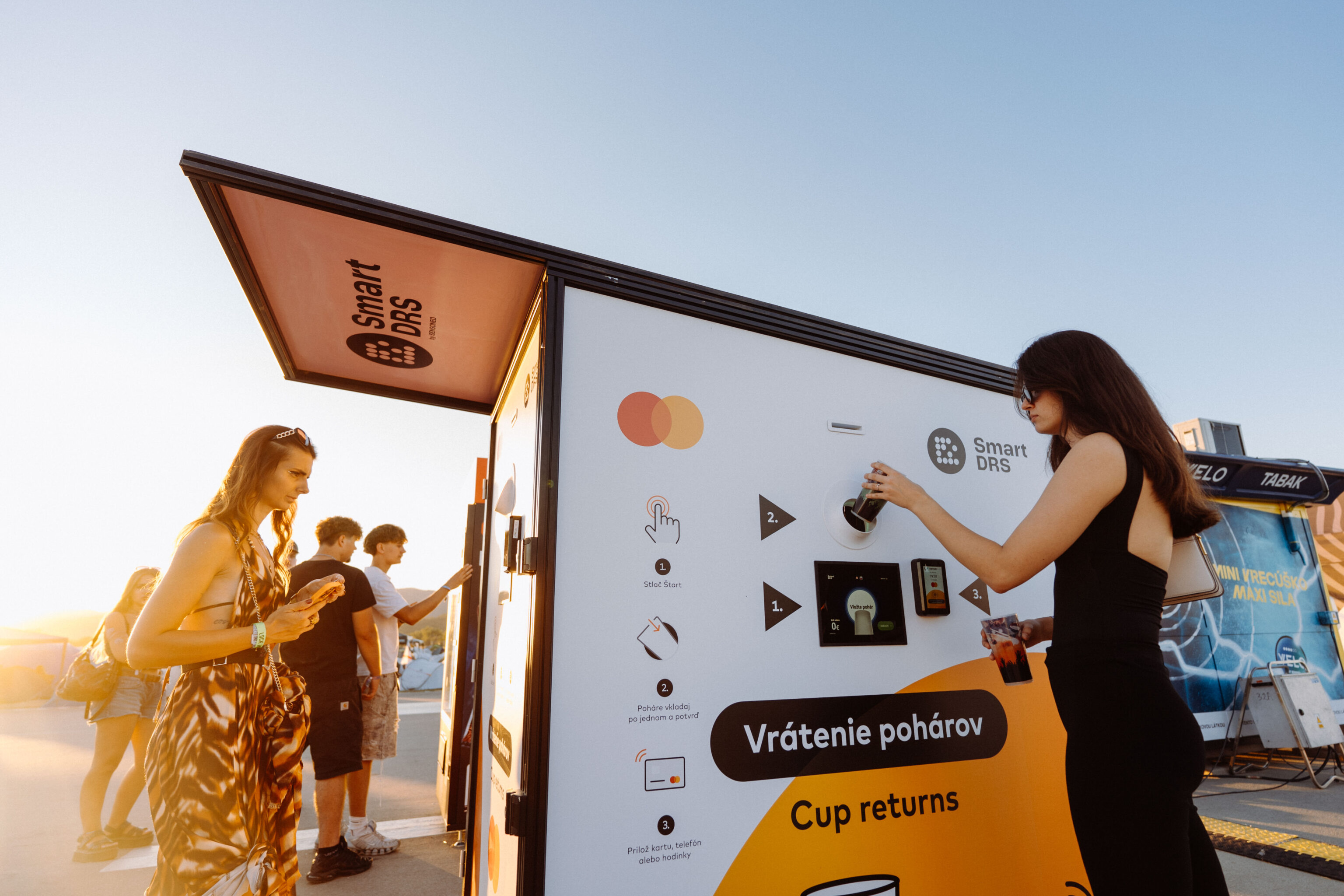
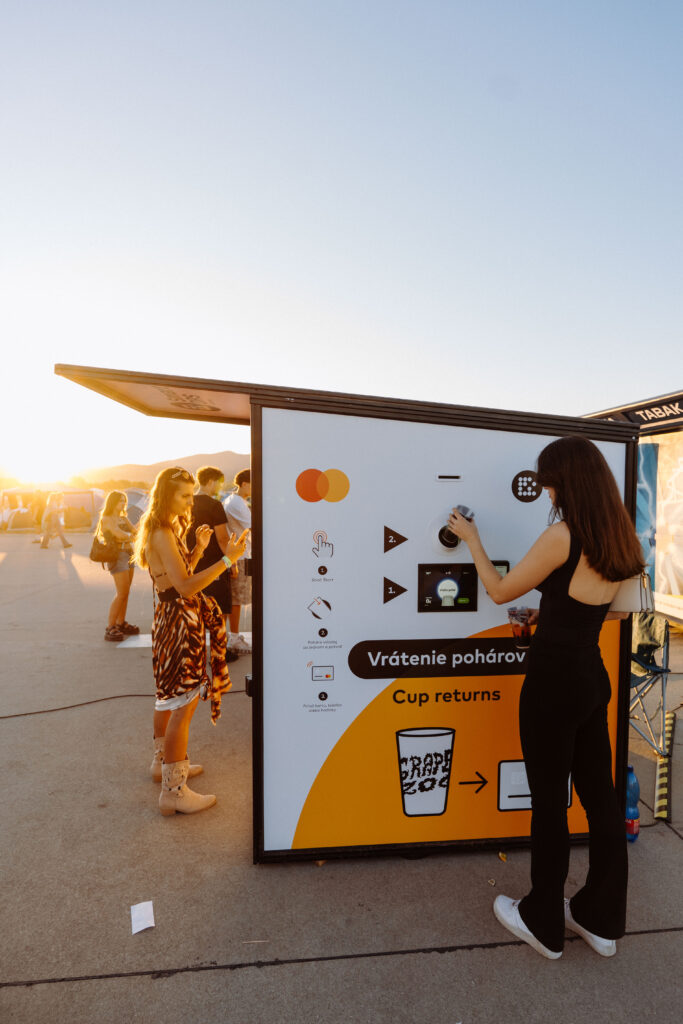
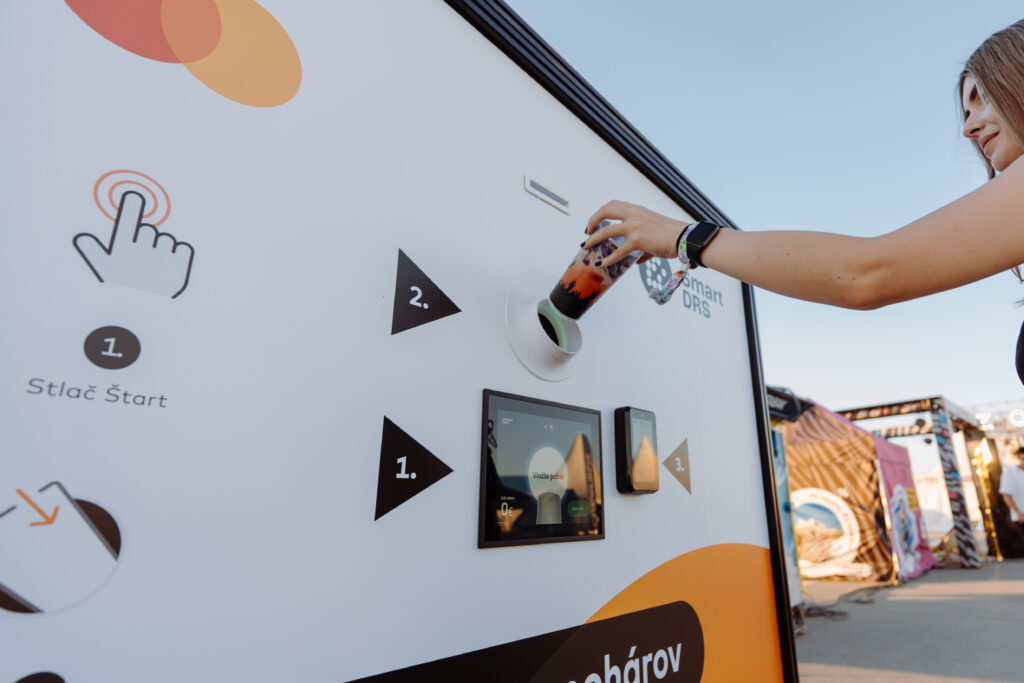
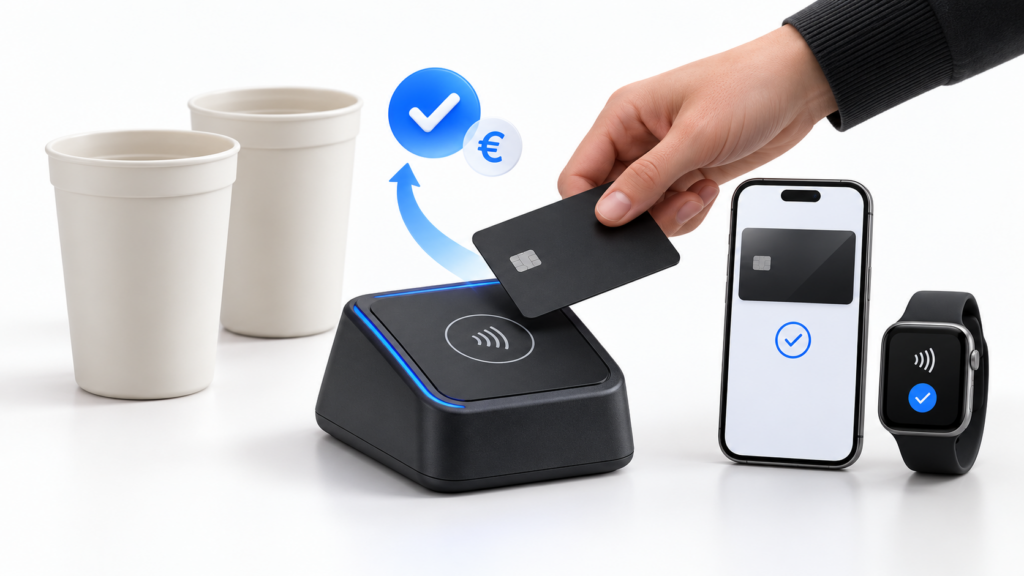
Automated returns with direct payment-card refunds offer a different approach. With Smart DRS, visitors can return eligible reusable cups at an automated collection point and receive the deposit directly to a payment card. They can use a physical card, mobile phone or smartwatch without downloading an app, registering an account or providing personal details.
For visitors, the process remains short and familiar. For operators, automated cup recognition and digital return records make it possible to separate cup returns from beverage sales, reduce manual handling and gain a clearer overview of return activity.
The payment method is only one part of the experience. Return stations still need to be visible, accessible and capable of handling demand at the right times. However, removing cash, registration and app requirements eliminates several common points of friction.
Readers who want to understand the individual steps can explore how a reusable cup deposit refund to a payment card works.
The role of technology is not to create motivation on its own. The deposit provides that motivation. Technology helps ensure that recovering it is simple enough to fit naturally into the visitor journey.
What We Have Learned from Automated Cup Returns at Events
At LOVESTREAM Festival 2026, Smart DRS recorded 42,585 reusable cup returns across 21,427 collection sessions, almost two cups per session. This matters for planning: return stations need to accommodate visitors bringing back several cups and refund their combined deposit in one transaction.
Return activity also came in waves, with a strong evening period and the highest activity around midnight. For operators, this means planning capacity around peak demand rather than daily averages. Visible return points along visitor routes, sufficient collection capacity and monitoring queues and fill levels are practical priorities.
Visitors could receive their deposits directly to a payment card without downloading an app or registering. Alongside accessible return points, this keeps the process simple when people are ready to leave.
These figures describe return activity, not the percentage of all cups issued that were recovered. They show how visitors used the system, rather than proving that one deposit model outperforms another.
Explore the LOVESTREAM Festival reusable cup return case study.
What Operators Should Measure
A reuse system cannot be evaluated only by counting how many cups or containers were returned. Return volume shows activity, but it does not reveal what proportion of the packaging issued by the operator came back.
To understand system performance, operators should monitor a defined set of metrics:
| Metric | What it shows |
| Packaging issued | The number of items entering circulation during a defined period or cycle |
| Packaging returned | The number of items collected back into the reuse system during a defined period or cycle |
| Return rate | The share of issued packaging returned within the same defined cycle |
| Loss rate | The share of packaging that was not recovered |
| Average use cycles | How many times an item circulates before it is lost, damaged or retired |
| Replacement cost | The cost of restoring inventory after losses |
| Returns by location | Which collection points visitors use and where access may be insufficient |
| Returns by time | When demand peaks and how capacity should be planned |
| Items per return | Whether users commonly return one item or several at once |
| Refund success rate | How reliably users receive their deposit through the selected refund method |
Clear measurement boundaries are essential. If a cup is returned, washed and issued again during the same event, it may generate several return records. Those records represent useful circulation activity, but they should not be confused with the percentage of unique packaging recovered at the end of the operating period.
Combining return, payment and operational data gives organisers a more complete picture. It helps them distinguish between a motivation problem, insufficient return access, capacity constraints and technical issues.
The purpose of measurement is not simply to report a large number of returns. It is to understand whether reusable packaging is completing enough cycles, where losses occur and what should change before the next event or service period.
A Deposit Creates Motivation, Convenience Converts It Into Returns
A reusable package creates value only when it comes back and can enter another use cycle. Without a clear incentive or accountability mechanism, more of the financial risk remains with the operator. But adding a deposit is only the beginning.
Users also need a return process that is visible, accessible and easy to complete. When the system combines a meaningful deposit with convenient return infrastructure, both parts reinforce each other: the deposit creates the reason to return, while the infrastructure removes the practical reasons not to.
For operators, this combination can support higher packaging recovery, reduce replacement pressure and provide better data for future planning. For visitors, it turns returning reusable packaging into a short and understandable part of the overall experience.
Smart DRS connects automated packaging recognition with direct payment-card refunds, allowing users to return eligible reusable packaging without cash, an app or account registration.
The goal is not to make reuse feel like an additional task. It is to make returning the packaging the easiest and most natural next step.
Frequently Asked Questions About Deposits in Reuse Systems
Can a reuse system work without a deposit?
Yes, but it still needs a clear mechanism that encourages users to return the packaging. This may include user accounts, return deadlines, non-return fees or rewards. Without a deposit or another form of accountability, the operator carries a higher risk of packaging loss.
Why are deposits important for reusable packaging?
A deposit assigns a clear financial value to the packaging. Users know that the amount can be recovered when the item is returned, creating an immediate and understandable reason to bring it back into the reuse system.
Does a higher deposit always lead to a higher return rate?
Not automatically. The deposit must be meaningful enough to motivate users, but it should also be proportionate to the item and operating environment. Return-point visibility, accessibility, capacity and refund convenience also influence whether packaging is returned.
What happens when reusable packaging is not returned?
Every unreturned item reduces the stock available for reuse and may need to be replaced. This increases operating costs and limits the number of use cycles the packaging can complete. A retained deposit may help cover the loss, but the purpose of the system is to bring packaging back into circulation.
Can reusable packaging deposits be refunded without cash or an app?
Yes. Automated systems can return deposits directly to a payment card without requiring cash handling, an app or account registration. This can simplify the experience for visitors and reduce manual work for operators.
Planning a Reuse System That Brings Packaging Back?
Smart DRS helps operators combine automated packaging recognition, convenient return infrastructure and direct payment-card refunds without cash handling, an app or account registration.
Explore how Smart DRS can support reusable packaging returns at your festival, stadium, venue or other high-traffic environment.